
Mon to  Sat 11:00 am to 8:00 pm

What is Obesity? And How do I know if I need a Bariatric Weight Loss Surgery

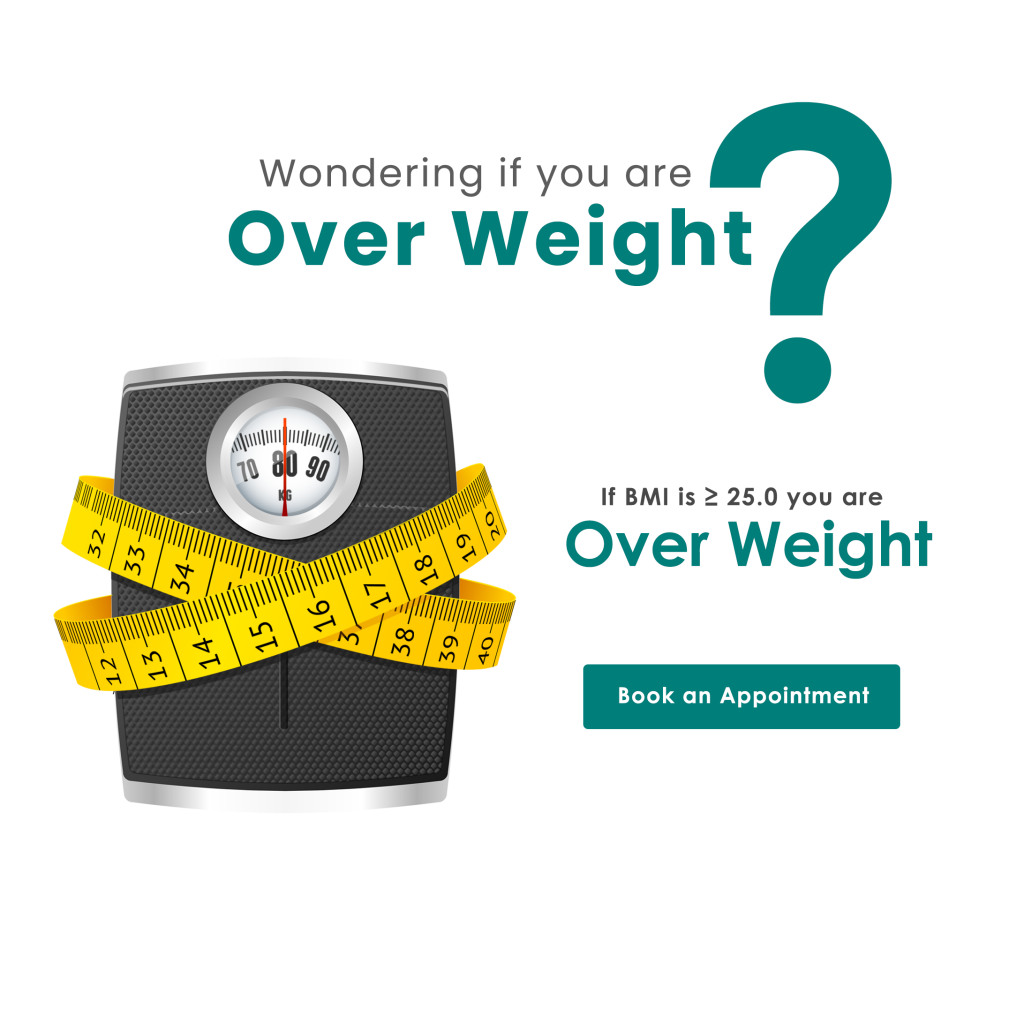
Obesity is the excessive deposition of fat in the body. When the BMI or body mass index of a person exceeds 25 then that person is called as obese. Obesity comes with many serious health issues such as diabetes, cardiovascular disease, joint pains and problems in completing the activities of daily living.

Obesity patients who are unable to lose the desired weight with lifestyle change and diet are those needing bariatric surgery or weight loss surgeries. These surgeries aim at reducing about 60 to 80 percent of the excess body weight. Dr. Sumeet Shah is the best bariatric surgeon in Delhi for all weight loss and diabetes related surgeries.   

BMI Calculator - Obesity Calculator

require
require require

Your BMI is......

BMIClassification
less than 18.5:Underweight
18.5 - 24.9:Normal weight
25 - 29.9:Overweight
30 - 34.9:Class I Obese
35 - 39.9:Class II Obese
40 upwards:Class III Obese

Laparoscopy Surgeries may seem simple, but need a lot of Experience and Dexterity

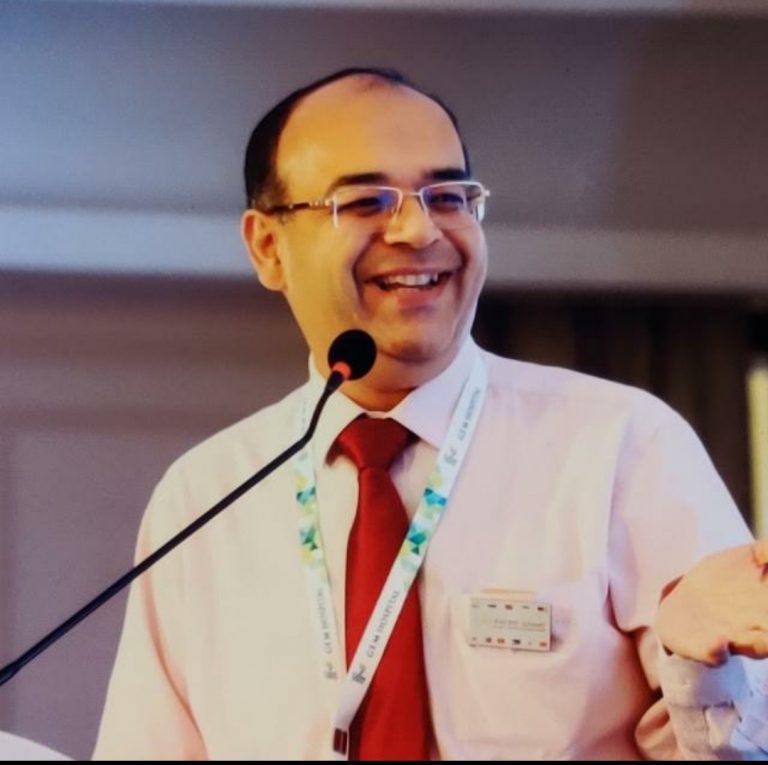
Dr Sumeet Shah has extensively trained and accomplished Laparoscopic & Bariatric Surgeon, he has been attached to some of the leading hospitals of Delhi. Dr Shah has been practicing Surgery for more than 20 years and has several thousand successful operations and satisfied patients to his credit.

Dr Shah has several presentations to his credit and has been invited as Faculty/ Expert at more than 100 National/ International meetings of Laparoscopic and Bariatric Surgeons.He has presented more than 50 invited papers at various specialist meetings. 

He is passionate to build trust and to provide highest standards of medical excellence, scientific knowledge and patient care.

Graduation (M.B.B.S) – Maulana Azad Medical College, New Delhi – 1993
Post graduate (M.S) in General Surgery – 1997
Diplomat of National Board (DNB) in General Surgery – National Board of Examination, Delhi.
Advanced training in Gastro-Intestinal Surgery – AIIMS, New Delhi
Post Doctoral Fellowship in Minimal Access Surgery and has received special training in Metabolic & Bariatric Surgery.
Fellowship – Indian Association of Gastro Intestinal Endosurgeons (FIAGES)
Advanced Laparoscopy Fellowship (FALS) in Metabolic / Bariatric and Hernia Surgery

0
Gastric Bypass Done
0
Sleeve Gastrectomy Done
0
Gastric Banding Done
0
Mini Gastric Bypass Done

About the Weight Loss (Bariatric Surgery) Procedures

Causes of Obesity

  • Sedentary Lifestyle
  • Genetics
  • High fat food consumption

Effects of Obesity on Health 

  • Diabetes
  • Cardiovascular Diseases
  • Digestive Problems such as acid reflux
  • Joint Problems
  • Obese people are prone to some cancers
  • Sleep apnea
  • Hormonal disturbances such as PCOD and Infertility
  • Depression 

What is Ideal Body Weight?

If you want to calculate your ideal body weight, then it can be done by deducting 100 from the Height (in cm). Eg. At a height of 160 cm – the ideal weight will be 60 kg and at 156 cm it will be 56 kg. Generally, if a person has more than 30 -35 kgs of their Ideal Body Weight – then they are candidates for Bariatric Surgery.
 
Research studies have shown that these procedures cause significant weight loss, recovery from diabetes, and improvement in cardiovascular risk factors, along with reduction in mortality rate of about 23% from 40%.
 
The U.S. National Institutes of Health recommends bariatric surgery for obese people with a BMI of at least 40, and for people with BMI 35 and coexisting medical conditions such as diabetes etc. However, new research suggests that the bariatric surgery should be appropriate for those with a BMI of 35 to 40 with no comorbidities or a BMI of 30 to 35 with significant comorbidities as well.


Types of Bariatric Surgeries for Weight Loss

Some of the most commonly performed surgeries for weight loss and with great results are – 

  • Gastric Bypass Surgery or RYGB or Roux-en-Y Gastric Bypass – this weight loss surgery is also known as Roux-en-Y gastric bypass. As the name suggests, the stomach is bypassed in this surgery by creating a small pouch out of it. This small pouch of the stomach known as the gastric pouch is created and then it is connected to the middle part of your small intestine. All this procedure is performed by (minimally invasive surgery) laparoscopy by making small incisions on the abdominal area. The small gastric pouch makes the patient feel full after the consumption of a small meal. The attachment to the intestine leads to the production of such hormones that the body’s energy consumption increases and the body starts losing weight at a faster pace. This gastric bypass surgery also leads to treatment or control of diabetes. Patients keep on losing weight within a period of 18 months and then it needs to be maintained. 
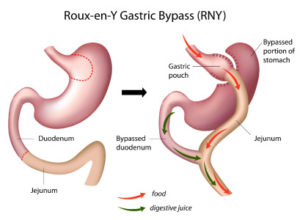
Gastric Bypass surgery

Around 113, 000 Gastric Bypass surgeries are perfomed annually in US as it is the gold standard of weight loss surgery.  

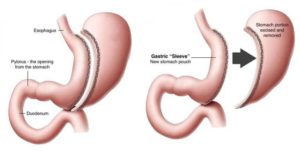
  • Sleeve Gastrectomy – In this weight loss surgery, a vertical sleeve is created out of the stomach and the rest of the stomach is sealed away. The vertical incision removes 70 to 80 percent of the stomach area leading to early fullness and speedy weight loss. The advantage of this surgery is that the intestines remain untouched and the digestive process remains the same. The fundus part of the stomach is removed in this surgery; this is responsible for the production of the hunger hormone ghrelin. When the fundus is removed, the patient will feel less hungry and will feel full soon. Also due to the sleeve gastrectomy, the food moves faster to the intestine as compared to before.  Sleeve Gastrectomy Bariatric Surgery for weight loss– After Sleeve Gastrectomy, most patients lose 30 to 50% of their excess body weight over a period of 6–12 months. There are many advantages of Sleeve gastrectomy other than weight loss, as it minimizes the chance of having an ulcer.
    – As intestines are not touched in this surgery, the risk of intestinal obstruction, and other problems such as anemia, osteoporosis, and protein or vitamin deficiency are significantly reduced.
    – Sleeve Gastrectomy is very effective as a first stage procedure (where two bariatric surgeries are required) for high BMI patients (BMI >55 kg/m2).
    – Results are great as a single stage procedure(only sleeve gastrectomy is performed) for low BMI patients (BMI 35–45 kg/m2).
    – It is a good option for patients having anemia, Crohn’s disease, IBS or irritable bowel syndrome, and various other conditions that make them unfit for intestinal bypass procedures.
  • Intragastric Balloon – It is the best procedure for those who are looking for a weight loss of about 10 to 15 kgs (for those having a BMI between 27.5 – 32.5) or for those who are looking for a bariatric surgery that is reversible. In this type of weight loss procedure, an intragastric inflated balloon is placed inside the stomach. This gives a feeling of fullness after a small serving of the meal. The patient tends to eat less often and in less quantity, this leads to weight loss. This intragastric balloon procedure can be performed in those patients who are not suitable for bariatric surgery or are waiting to fulfill the criteria for it. This is a non-invasive procedure as the balloon is placed via endoscopy. It is placed for about 6 months to 1 year of time after which it is deflated and removed via endoscopy. The balloon is filled with a blue color liquid and if it punctures accidentally, then your urine will turn blue, it must be notified immediately. The weight loss with this surgery is variable as it depends largely upon the patient’s lifestyle modification. You must not plan to get pregnant while the balloon is in place. 
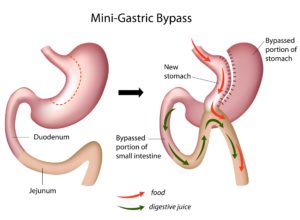
  • Mini Gastric Bypass – It is a combination of sleeve gastrectomy and gastric bypass. In this mini gastric bypass surgery, the gastric sleeve is created and it is attached to the last part of the small intestine. This surgery has comparable benefits to gastric bypass surgery. The patient can consume a better quantity of food in this type of surgery. However, the frequency of passing stool may increase as well. Patients lose almost 70 to 80 percent of their excess body weight with this type of surgery. mini gastric bypass surgery for weight loss
FAQs about Weight Loss (Bariatric Surgery) Procedure

  • You have a higher BMI than normal (more than 32) and you are suffering from diseases related to obesity. 
  • Your quality of life is hampered due to obesity such as type 2 diabetes, sleep apnea, joint pains, digestive disorders, etc. 
  • You are unable to move around freely and unable to perform your daily activities to your full efficiency.
  • You feel socially awkward while going out in public due to your obesity. 
  • You are unable to lose the desired weight with diets and exercise regimes. 
  • You are between 10 to 70 years of age. 
  • Reduction in 65 to 80 percent of weight loss within 6 to 12 months of surgery
  • Lifestyle changes
  • Personality upliftment
  • Social anxiety decreases considerably
  • Pre-surgery tests are performed 
  • Thromboembolism check-up is done
  • Occasionally a Very Low-Calorie Diet (VLCD) is started in severely obese patients
  • Smoking and Alcohol have to be stopped completely
  • Breathing exercises and mobility are encouraged
  • Loss of 3 – 5 kgs. before Surgery can help during the operation and in post-operative recovery

A few small incisions are made in the abdomen and the probes are passed through them. These probes have a small camera attached to them. This allows the surgeon to operate the probes with the guided screen. 

These incisions can be stitched, stapled or they are stuck together with surgical glue. You will have minimal scars and you can take bath after the surgery.

  • One of the most experienced bariatric surgeons in Delhi & India
  • He is an accredited trainer for other Surgeons who want to learn Bariatric Surgery
  • He has operated in many live surgery workshops and on VIP patients
  • He is a senior member and serves on the Executive Committee of the Obesity Surgery Society of India (OSSI)
  • His results are regularly audited
  • His research work in the field of Obesity Surgery has been published in reputed journals
  • He has been associated as Chief Bariatric Surgeon with some of the most reputed hospitals in Delhi. 
  • He is very patient-friendly, approachable and takes good post-operative care
  • Other diseases related to obesity are also treated with weight reduction. 
  • A number of patients have shown full treatment or control over diabetes, high blood pressure, sleep apnea, anxiety, liver, and digestive disorders, joint diseases, and headaches. 
  • You will see a dramatic improvement in your ability to walk, run and exercise.
  • Mood upliftment and personality improvement always happen after weight loss surgery. 
  • You will become more efficient at work and more independent in your daily chores.

Malnutrition and Reflux are some of the most common side-effects of weight-loss surgery, but they can be taken care of with proper diet and lifestyle modification.

You will be able to walk a few hours after surgery. Dr. Sumeet Shah believes in the early mobilization of the patient to get faster recovery and great results.

It varies with the specific type of surgery you have gone through and your overall health condition. In some surgeries you can go home the next day, others require hospitalization of 2 to 3 days.

You will be able to eat a normal diet after recovery but the amount or portion you used to eat decreases considerably. Some dietary advice needs to be followed religiously to achieve the desired weight loss. 

Yes, in order to lose weight and to maintain the lost weight, you must follow a healthy diet in adequate proportions as per your weight and the surgery you have gone through.

Call Now Button