

The Appendix is a small finger-like projection attached to the large intestine on the lower abdomen on the right side. When this Appendix gets inflamed, then it needs to be removed urgently to avoid the spread of infection and its burst as well. Dr Sumeet Shah is the best Laparoscopy Surgeon in Delhi for Appendix Surgery.
If you are looking for the best Appendix surgeon in Delhi who is experienced in both simple and complex minimal invasive surgeries, then Visit Spandan Multispecialty Clinic today. Affordable Appendix removal treatment from one of the best general Surgeon in Delhi, NCR. If you live near GK in Delhi and looking for the best general surgeon in GK2, book an appointment here.
Dr Sumeet Shah has extensive experience in Spleen Surgery, Weight loss/bariatric surgeries, gallbladder surgeries, diabetes surgeries and other advanced gastrointestinal surgeries like Whipple Procedure for pancreatic tumor.
MBBS (MAMC), MS, DNB, MNAMS, Fellowship (MAS), FIAGES, FALS (Bariatric), FALS (Hernia)
Director & Head
Minimal Access, Metabolic & Bariatric Surgery (M.A.M.B.S)
E.C Member – Obesity & Metabolic Surgery Society of India (O.S.S.I)
Co-Organising Secretary & Scientific Chair – OSSICON 2020 (www.ossicon2020.com)
Vice President – Hernia Society of India (H.S.I)
Ex Vice President (North) & E.C Member – Indian Association of Gastrointestinal Endosurgeons (I.A.G.E.S)
Ex E.C Member – Delhi Chapter of A.S.I
The Appendix is a small finger-like projection attached to the large intestine on the lower abdomen on the right side. It serves no function in the body after the initial years of age. It helps in boosting the immunity of the baby in the first 3-4 years, after that, it serves no function at all that’s why it is called a vestigial organ as well.
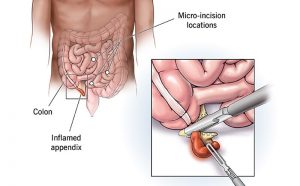
When the appendix gets inflamed, it is known as appendicitis. The only permanent treatment of appendicitis is the removal of the appendix and if not treated well in time, it can rupture leading to a medical complication. The ruptured appendix can lead to peritonitis, which is an infection of the lining of the abdominal wall. This is a medical emergency and can be life-threatening if not treated well in time.
After giving anesthesia to the patient, a few small incisions are made in the lower abdomen area. Carbon dioxide gas is filled inside the abdomen to allow for a clear view of organs and prevent any other organ from any kind of damage. The probes are inserted through these incisions which have a camera attached to them. The inner organs are viewed on the screen outside with the help of that camera. The appendix is removed via the laparoscopy tools and taken out from one of these incisions. The incisions are then closed with surgical glue and the patient is sent to the recovery room.

Appendicitis or inflammation of the appendix is the most common reason to perform appendectomy surgery. The other less common reasons are appendix tumor, recurrent appendicitis, appendix abscess, and mucocele of the appendix.
When certain substance gets stuck inside the appendix such as stool, mucus, bacteria, etc., then it creates infection in the appendix. As the substance present in the appendix is not able to move out efficiently, they get stuck there and infect the area. If not treated well in time, these substances can leak into the abdominal cavity and cause many life-threatening complications.
Other than physical Examination, Ultrasound is the mainstay of diagnosis in which the appendix is seen swollen or perforated. Blood tests and urine tests are also required to check for the level of infection in the body. CT scan can also be ordered if required.
The open appendix surgery is rarely performed in case the appendix has burst inside and the abdominal linings need to be washed to prevent or treat peritonitis.
You can go home the next day after the appendix removal surgery.
The laparoscopy surgery